Back in the fall/early winter, I was approached by my supervisor about whether or not I wanted to renew my contract for another year. If I said yes, I would have been the first ALT to stay for longer than three years in this town. I was very happy to hear this offer, as that meant that they wanted me to stay and because I had been enjoying life here so much that I wouldn't mind extending my stay even longer.
So I had to weigh my options.
The plan was (and currently still is) to apply to medical schools this summer, with matriculation into medical school a year later, in the Fall of 2014. If I stayed on the JET Program for a fourth year, timing would be perfect: completion of the fourth year would coincide with the start/orientation for medical school. I would also be making the most out of my new iPhone 5 contract (which I started in October) and my syaken car inspection, which lasts for two years (and is currently being done).
My life in Japan is super fun; everyday is like an adventure. My Japanese language skills have increased dramatically since I first arrived, and even back then, they weren't too bad. Can I read a Japanese newspaper? No. Can I read Japanese manga (comics)? Yes. Well, for the most part. If I come across a word/kanji I don't know (which is often), I have my trusty "Imiwa?" app to help me. Can I watch a Japanese movie or anime? Yes, unless it's filled with jargon I don't know; but I understand at least the basic gist. What I can't do quite yet, though, is enjoy a Japanese video game that has lots of important or detailed story elements like Metal Gear Rising. I had been waiting for that game for months, and finally when it was released, I went and bought it. And most PS3 games have multiple language data on the disk, so as long as my PS3 is set to "English," the game will be, too. But noooooooooooooo, Konami decided to separate the language data between versions of the game. My theory is that because the game was released on PS3 and XBox360, Microsoft demanded that the content on the disks be exactly the same; and with a smaller capacity disk that XBox360 uses, it's likely that there are no options for multiple languages on them. Anyway, point is, I was super disappointed, and my language and kanji skills don't suffice to enjoy the conversation-heavy game to the extent that I'd like. I digress...
If I stayed in Japan longer, perhaps I could get to that point. I would need to buckle down and start learning and memorizing new vocabulary, new kanji, perhaps new grammar points. Well, at some point, I'd like to get to it. Staying in Japan would also allow me to have more opportunities to do things I haven't done yet, such as: racing up and down the mountain roads Initial D-style in Gunma Prefecture, feeding the deer in Nara, checking out Himeji Castle, exploring the beautiful shrines and temples in Nikko, climbing Mt. Fuji, or practicing some karate in Okinawa. But staying in Japan on JET for a fourth year creates a glaring problem when it comes to...
...Medical school interviews. The plan is to apply during this application cycle. That means taking the MCAT soon (April!), submitting the application materials in June, and doing interviews in the fall/winter. The problem is that I don't know when the schools would want to interview. And if I were in Japan, I would have to purchase an international round trip plane ticket to go and interview. And I would have to purchase another ticket for another interview at a different school. And again for another. That would get quite expensive. Plus, I wouldn't have the vacation days to be able to call off work so many times, and it would be a huge inconvenience to both my coworkers and my students. In theory, I could try to schedule all of my interviews at the same time/week/month, or better yet, during the holidays when I could be home. But that would force the application committee (and me) to wait. That would be no different from prolonging the application itself, and if I learned anything from past applications, it's that timing is everything. The earlier, the better.
So, I must come home! That means a lot of things. It sucks because now I know that the limits are set. I've always known that my time in Japan with the JET Program would be limited, but somehow it's sobering to know exactly when I have to go. Kinda sucks. But hey, at least I know exactly how much time I have left, and I could plan it to use the time wisely, right?
Lately, I've been doing a lot of MCAT review. So a lot of my time is spent with my head in the books. Well, book. Speaking of which, I still gotta finish today's review!
Word of the Day: 選択 「せんたく」 "sentaku," which means "selection," "choice," or "option."
Showing posts with label language. Show all posts
Showing posts with label language. Show all posts
Tuesday, March 26, 2013

Tuesday, January 18, 2011
Words of Wisdom
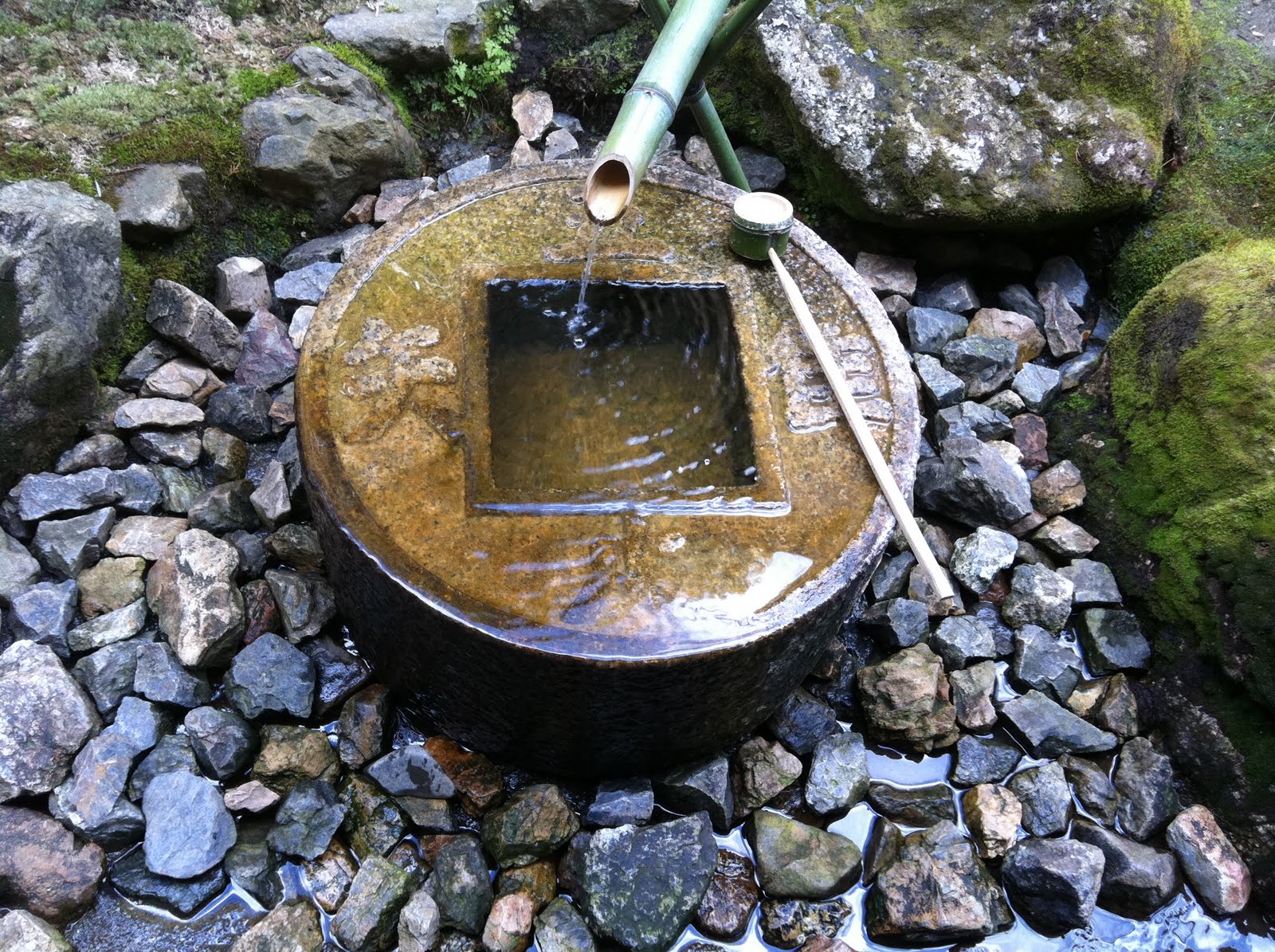
I learned a very interesting new phrase. 吾唯足知。「われただたるをしる。」 "Ware tada taru (wo) shiru." Its meaning is very similar to the phrase, "Be happy with what you have." (Literally, it says, "I know just enough.") Another way to put it is, "What I have is all I need." The most interesting thing about this phrase is that it can be written with just one 口 in the middle of the four other radicals, so that it looks something like this, found at Ryoanji (Temple), in Kyoto.

I had Karate practice last night. My body is so sore! Anyway, this time, there were more students, so we actually had a more formal class. Interestingly enough, the other students were in 2nd, 4th, and 5th grades, and all at least Brown Belts. Hah! Wonderful. :-) At the end of class, we recited the Dojo-Kun, which is basically the school's motto or rules. Well, it's actually more like a "code of honor." There are five things, and each is numbered "1." because each is just as important as the other.

訓
一。 人格感性に努むること。
一。 誠の道を守ること。
一。 努力の精神を養うこと。
一。 礼儀を重んずること。
一。 血気の勇を戒むること。
Next time, I will explain them all. :-) But for now, I must take care of quite a few things, as tomorrow is the mid-year conference, a friend from the US is visiting this Thursday, I have to submit my test on (by?) Thursday, and I also have to submit my contract renewal yes/no sheet. So much to do, so little time!
Phrase of the day: 吾唯足知。
I had Karate practice last night. My body is so sore! Anyway, this time, there were more students, so we actually had a more formal class. Interestingly enough, the other students were in 2nd, 4th, and 5th grades, and all at least Brown Belts. Hah! Wonderful. :-) At the end of class, we recited the Dojo-Kun, which is basically the school's motto or rules. Well, it's actually more like a "code of honor." There are five things, and each is numbered "1." because each is just as important as the other.

訓
一。 人格感性に努むること。
一。 誠の道を守ること。
一。 努力の精神を養うこと。
一。 礼儀を重んずること。
一。 血気の勇を戒むること。
Next time, I will explain them all. :-) But for now, I must take care of quite a few things, as tomorrow is the mid-year conference, a friend from the US is visiting this Thursday, I have to submit my test on (by?) Thursday, and I also have to submit my contract renewal yes/no sheet. So much to do, so little time!
Phrase of the day: 吾唯足知。
Thursday, January 6, 2011
Word of the Year
I learned today, at Dictionary.com that the "Word of the Year" for 2010 was "epic."
What an utter disappointment. Well, at least it wasn't a surprise. I've heard this word used so often this past year or two that it's even become a part of my normal lexicon. It's annoying when words aren't used properly, but even I'm guilty of such crimes ("awesome"). But to hear that "epic" is the new "awesome" is...I don't know...a tad bit annoying. Perhaps because it's used primarily by the younger generation; like they're trying too hard to be cool or something. Anyway, I try to look at it the same way I look at Time Magazine's Person of the Year: the winner was chosen as a result of a combination of things, from popularity (person), usage (word), or otherwise something of a representation of a major event or occurrence that year. In Mark Zuckerberg's case, he was simply the biggest douche of 2010. Well, more like 2004. "Epic" was something like that. Just not nearly as bad.
On a related note, the kanji 暑 was chosen as the "Kanji of the Year" for 2010 here in Japan. It means "hot/heat," and describes the ridic heat in 2010. I personally would have chosen 高, as it means "high/tall," and can be used to describe both the weather and the high value of the Yen.
Kanji of the day: 帰 from 帰る 「かえる」 "kaeru," which means "to return (home)." 'Cause that's what I'm about to do! Peace out!
What an utter disappointment. Well, at least it wasn't a surprise. I've heard this word used so often this past year or two that it's even become a part of my normal lexicon. It's annoying when words aren't used properly, but even I'm guilty of such crimes ("awesome"). But to hear that "epic" is the new "awesome" is...I don't know...a tad bit annoying. Perhaps because it's used primarily by the younger generation; like they're trying too hard to be cool or something. Anyway, I try to look at it the same way I look at Time Magazine's Person of the Year: the winner was chosen as a result of a combination of things, from popularity (person), usage (word), or otherwise something of a representation of a major event or occurrence that year. In Mark Zuckerberg's case, he was simply the biggest douche of 2010. Well, more like 2004. "Epic" was something like that. Just not nearly as bad.
On a related note, the kanji 暑 was chosen as the "Kanji of the Year" for 2010 here in Japan. It means "hot/heat," and describes the ridic heat in 2010. I personally would have chosen 高, as it means "high/tall," and can be used to describe both the weather and the high value of the Yen.
Kanji of the day: 帰 from 帰る 「かえる」 "kaeru," which means "to return (home)." 'Cause that's what I'm about to do! Peace out!
Tuesday, November 16, 2010
Ninja Post
I have lots of news! Well, not lots, actually. Just a little. And as per usual, I shall write things in reverse chronological order. And in a numbered outline format. 'Cause it's annoying. :-)
1) I got my reappointment contract today. It's due on February 4th, but my supervisor (Supes) asked that I decide by January 20th. Way to make a difficult decision even more difficult. >_<
2) I am in the Osaki City newspaper! Osaki is the large city north of me; it's not actually a "city" per se; more like a district or county. 'Cause there are many towns and an actual city in Osaki. But yeah, a photographer came one day after I was teaching the Kindergarten class, and the other teachers told me to join in the picture! So I did! I'll try to take a picture of it and post it up, if I can.
3) It is cold. Like, really cold. It was 3°C this morning. BRRRRR!!! It sucks. I miss insulation badly. My heaters heat really well, and I thought I got used to the smell, but I was wrong. Well, I should put it this way; when the heaters are running, it smells fine. But when the heaters are either starting or stopping, they ventilate themselves, so the fumes get all spread out. It's especially annoying when I turn off my bedroom heater before I go to sleep.
4) There are a bunch of games that have been released (or are coming out soon) that I really want to buy. But they're hard to get, 'cause I have to import them from the US. But that means I have to buy a PS3. And that also means I have to connect it to my SDTV. Which finally means I have to find the time to play it.
5) I have a hard enough time finding the motivation to study, let alone properly manage my schedule. Well, I've been keeping up with all of my normal responsibilities; just not studying Japanese. Maybe it's because of how the text book is set up? You know: really annoyingly.
6) So, my car broke down the other day. Well, not exactly. But over the past two or three weeks, it had been giving me a slight bit of trouble. It wouldn't start right away; I would turn the key, and the engine would chug a couple times before it started. It was a sign that I needed a new battery. So I asked my friends about it that weekend; how to go about getting a new battery, and possibly an oil change. I had a feeling the oil needed to be changed. Well, one day, I was driving towards a convenience store about 3 kilometers south. When I got to about 2.5, I noticed the car started acting funny; something felt weird. Well, when I pulled into the parking lot, the car was slowly choking, and finally it just DIED, two feet before I was completely in the spot. So, I put it in park, pulled the handbrake, and stepped outside. I had a feeling something was wrong with the oil. I don't know how I knew this, but I knew I had to check it. So I went inside, bought a towel to use as a rag, some work gloves, and some food (which was my original intent). I went back outside to my car, popped the hood, and began the procedures. When I checked the dipstick for the oil level, my heart dropped. There was barely enough oil to touch the dip stick, let alone the minimum level that should be in the car. So, I had to fill it up. Thankfully, my predecessor left a container of engine oil in the trunk, in case something like this should happen (Thank you!); I guess it was foreseen? Or it happened before? Anyway, I was trying to open the container. For about five minutes. No matter how I turned the cap, it wouldn't open. Finally, I mustered up the courage to ask a passersby. The guy was like, "Here, do this," and he touched the cap. With a *pop!* it magically opened. Feeling like an idiot, I thanked him and took it back. I emptied the container, and filled the oil up so that it was right in the middle of the appropriate level according to the dipstick. It really must have been foreseen. So, after letting the car run for a few minutes, the engine sounded normal again, and I drove safely home.
7) One day, I couldn't even start my car. "Dammit! Effin' battery!" I shouted. I stepped out of the car, bowed to a neighbor as he was throwing out the trash, and said, "My car won't..." I couldn't think of how to say it, so I went Filipino-style, "My car won't open." He asked, "Is it locked? Did you use your key?" And I was showing him that it wouldn't start. I demonstrated. We agreed that it was the battery. So, he waved to a guy in a truck that was driving by. They looked like old friends; the first guy told the truck guy what the problem was, so the truck guy drove off to find the jumper cables. Eventually, he came back, and my neighbor helped me get my car started. Having arrived at work a couple minutes late (I called as soon as I couldn't start my car), I explained the situation, and one of my JTE's called his mechanic to come in and change out the battery. That day. In the school parking lot. What nice guys! And what great service!
8) Kyoto soon. :-)
Word of the day: 面倒くさい 「めんどうくさい」 "mendou-kusai," which means "troublesome" or "annoying." I added the hyphen because it is actually a root word, mendou, which itself means "an annoyance" or "a troublesome (thing)," and "kusai," which means "reeks of". "Kusai" can be used to say, "smelly" or "stinky." Like, "Gross, man, that stinks! くさい!"
1) I got my reappointment contract today. It's due on February 4th, but my supervisor (Supes) asked that I decide by January 20th. Way to make a difficult decision even more difficult. >_<
2) I am in the Osaki City newspaper! Osaki is the large city north of me; it's not actually a "city" per se; more like a district or county. 'Cause there are many towns and an actual city in Osaki. But yeah, a photographer came one day after I was teaching the Kindergarten class, and the other teachers told me to join in the picture! So I did! I'll try to take a picture of it and post it up, if I can.
3) It is cold. Like, really cold. It was 3°C this morning. BRRRRR!!! It sucks. I miss insulation badly. My heaters heat really well, and I thought I got used to the smell, but I was wrong. Well, I should put it this way; when the heaters are running, it smells fine. But when the heaters are either starting or stopping, they ventilate themselves, so the fumes get all spread out. It's especially annoying when I turn off my bedroom heater before I go to sleep.
4) There are a bunch of games that have been released (or are coming out soon) that I really want to buy. But they're hard to get, 'cause I have to import them from the US. But that means I have to buy a PS3. And that also means I have to connect it to my SDTV. Which finally means I have to find the time to play it.
5) I have a hard enough time finding the motivation to study, let alone properly manage my schedule. Well, I've been keeping up with all of my normal responsibilities; just not studying Japanese. Maybe it's because of how the text book is set up? You know: really annoyingly.
6) So, my car broke down the other day. Well, not exactly. But over the past two or three weeks, it had been giving me a slight bit of trouble. It wouldn't start right away; I would turn the key, and the engine would chug a couple times before it started. It was a sign that I needed a new battery. So I asked my friends about it that weekend; how to go about getting a new battery, and possibly an oil change. I had a feeling the oil needed to be changed. Well, one day, I was driving towards a convenience store about 3 kilometers south. When I got to about 2.5, I noticed the car started acting funny; something felt weird. Well, when I pulled into the parking lot, the car was slowly choking, and finally it just DIED, two feet before I was completely in the spot. So, I put it in park, pulled the handbrake, and stepped outside. I had a feeling something was wrong with the oil. I don't know how I knew this, but I knew I had to check it. So I went inside, bought a towel to use as a rag, some work gloves, and some food (which was my original intent). I went back outside to my car, popped the hood, and began the procedures. When I checked the dipstick for the oil level, my heart dropped. There was barely enough oil to touch the dip stick, let alone the minimum level that should be in the car. So, I had to fill it up. Thankfully, my predecessor left a container of engine oil in the trunk, in case something like this should happen (Thank you!); I guess it was foreseen? Or it happened before? Anyway, I was trying to open the container. For about five minutes. No matter how I turned the cap, it wouldn't open. Finally, I mustered up the courage to ask a passersby. The guy was like, "Here, do this," and he touched the cap. With a *pop!* it magically opened. Feeling like an idiot, I thanked him and took it back. I emptied the container, and filled the oil up so that it was right in the middle of the appropriate level according to the dipstick. It really must have been foreseen. So, after letting the car run for a few minutes, the engine sounded normal again, and I drove safely home.
7) One day, I couldn't even start my car. "Dammit! Effin' battery!" I shouted. I stepped out of the car, bowed to a neighbor as he was throwing out the trash, and said, "My car won't..." I couldn't think of how to say it, so I went Filipino-style, "My car won't open." He asked, "Is it locked? Did you use your key?" And I was showing him that it wouldn't start. I demonstrated. We agreed that it was the battery. So, he waved to a guy in a truck that was driving by. They looked like old friends; the first guy told the truck guy what the problem was, so the truck guy drove off to find the jumper cables. Eventually, he came back, and my neighbor helped me get my car started. Having arrived at work a couple minutes late (I called as soon as I couldn't start my car), I explained the situation, and one of my JTE's called his mechanic to come in and change out the battery. That day. In the school parking lot. What nice guys! And what great service!
8) Kyoto soon. :-)
Word of the day: 面倒くさい 「めんどうくさい」 "mendou-kusai," which means "troublesome" or "annoying." I added the hyphen because it is actually a root word, mendou, which itself means "an annoyance" or "a troublesome (thing)," and "kusai," which means "reeks of". "Kusai" can be used to say, "smelly" or "stinky." Like, "Gross, man, that stinks! くさい!"
Monday, October 18, 2010
So busy!
Wow, I've been so busy these past couple weeks! My time at the Junior High has been spent helping my students prepare for the Culture Festival that happened this past weekend. It was basically a collection of performances by the students; mostly musical. Some danced, some played an instrument, all of them sang; it was a good time. I was the camera man. At one point, I was recording video using both the school's digital camcorder and my own iPhone. Hah! Hilarious. And kinda difficult.
And this week, both of my elementary schools are throwing a show with singing, dancing, and acting performances, too! I saw the dress rehearsal today; I was impressed by their ability to remember all of those lines! Especially the ones who were doing rapid-fire paragraph-long speeches as comic relief. They were also wearing various types of clothes, from school uniforms to kimono, to farmers' clothing. It was very interesting. Oh, and the fifth graders did a taiko drum performance followed by yosakoi dancing. Rock on!
Ah, Yosakoi. So, there was a yosakoi festival last week in Sendai. It was splendid. I will post a video here so you know what yosakoi is; or better yet, just do a search on google and youtube so you can read info and watch some dances. It's awesome.
This week, I just got my JET Programme Japanese Language Course Textbook and Workbook. Being placed into the advanced level, I have been given text books whose lessons are in Japanese. This will provide good reading practice and introductions to a wealth of new vocabulary. What sucks is that the first few lessons will be super tough, 'cause I'll have to stop every 30 seconds to look up a word I don't know that's in the lesson. >.< The workbook I was given has 504 kanji; most of which I've never learned before, or even seen. This is gonna be a challenge! I need to figure out how to pace myself for this. Let's break it down.
The course is split up into six textbooks, each distributed one month apart, from October 18 to March 17. We are given about a month and a half to complete each book, take a 50-question multiple choice test, and mail the test to the language center. The lessons in the book are designed to be completed on a daily basis over a span of four weeks; each lesson is four pages long, and there are five lessons per week, for a total of 20 lessons per book. So, it's already established that I'll be doing 4 pages of lessons per day. But what's unclear is the kanji workbook.
The kanji workbook was designed for self-study, and it is not included in the test. There are 504 kanji that the book gives. So if I split it up as evenly as possible, that means 84 kanji per month, or 21 kanji per week. Which means 4-5 kanji per lesson. That's not bad. I think.
The thing is, this is the breakdown for the kanji if I want to study them in the traditional fashion. But I've observed that it's much easier to forget kanji when it's learned in this way, and Heisig's method seems to actually work; it works in both remembering the meaning and how to write the kanji. So, I think I'll supplement my JET kanji studies with lessons from Heisig. This ends up doubling the amount of kanji I learn per day, and I'll go through 1000 by next April. But actually...I had this crazy idea in my head that I could get through all 1945 joyo kanji by this time, next year. Which, I guess is possible, if I maintain that pace of 42 kanji/week. Damn, that's 8-9 kanji a day. Back in college, we had 13 kanji a week, or so. Then again, I usually didn't study until the night before for an hour, and I managed to remember them. Alright, it's doable. I just have to bust my ass. :-)
Let me end this post by circling back to the topic I opened with: festivals. There is a massive Jidai Matsuri in Kyoto this weekend. Actually, it's this Friday. And I REALLY WANT TO SEE IT. So that means I'll be calling off work for the first time this week. Neat. I'm also excited to see my girlfriend. She's planning a little get-together/movie night with some friends, so I'll get to meet them and watch a good ol' Disney movie. We'll also check out another temple this weekend. It'll be great!
Side note: please read the comments of my previous post to find out what I learned about the milk here in Japan!
Word of the Day: 忙しい 「いそがしい」 "isogashii," which means "busy."
And this week, both of my elementary schools are throwing a show with singing, dancing, and acting performances, too! I saw the dress rehearsal today; I was impressed by their ability to remember all of those lines! Especially the ones who were doing rapid-fire paragraph-long speeches as comic relief. They were also wearing various types of clothes, from school uniforms to kimono, to farmers' clothing. It was very interesting. Oh, and the fifth graders did a taiko drum performance followed by yosakoi dancing. Rock on!
Ah, Yosakoi. So, there was a yosakoi festival last week in Sendai. It was splendid. I will post a video here so you know what yosakoi is; or better yet, just do a search on google and youtube so you can read info and watch some dances. It's awesome.
This week, I just got my JET Programme Japanese Language Course Textbook and Workbook. Being placed into the advanced level, I have been given text books whose lessons are in Japanese. This will provide good reading practice and introductions to a wealth of new vocabulary. What sucks is that the first few lessons will be super tough, 'cause I'll have to stop every 30 seconds to look up a word I don't know that's in the lesson. >.< The workbook I was given has 504 kanji; most of which I've never learned before, or even seen. This is gonna be a challenge! I need to figure out how to pace myself for this. Let's break it down.
The course is split up into six textbooks, each distributed one month apart, from October 18 to March 17. We are given about a month and a half to complete each book, take a 50-question multiple choice test, and mail the test to the language center. The lessons in the book are designed to be completed on a daily basis over a span of four weeks; each lesson is four pages long, and there are five lessons per week, for a total of 20 lessons per book. So, it's already established that I'll be doing 4 pages of lessons per day. But what's unclear is the kanji workbook.
The kanji workbook was designed for self-study, and it is not included in the test. There are 504 kanji that the book gives. So if I split it up as evenly as possible, that means 84 kanji per month, or 21 kanji per week. Which means 4-5 kanji per lesson. That's not bad. I think.
The thing is, this is the breakdown for the kanji if I want to study them in the traditional fashion. But I've observed that it's much easier to forget kanji when it's learned in this way, and Heisig's method seems to actually work; it works in both remembering the meaning and how to write the kanji. So, I think I'll supplement my JET kanji studies with lessons from Heisig. This ends up doubling the amount of kanji I learn per day, and I'll go through 1000 by next April. But actually...I had this crazy idea in my head that I could get through all 1945 joyo kanji by this time, next year. Which, I guess is possible, if I maintain that pace of 42 kanji/week. Damn, that's 8-9 kanji a day. Back in college, we had 13 kanji a week, or so. Then again, I usually didn't study until the night before for an hour, and I managed to remember them. Alright, it's doable. I just have to bust my ass. :-)
Let me end this post by circling back to the topic I opened with: festivals. There is a massive Jidai Matsuri in Kyoto this weekend. Actually, it's this Friday. And I REALLY WANT TO SEE IT. So that means I'll be calling off work for the first time this week. Neat. I'm also excited to see my girlfriend. She's planning a little get-together/movie night with some friends, so I'll get to meet them and watch a good ol' Disney movie. We'll also check out another temple this weekend. It'll be great!
Side note: please read the comments of my previous post to find out what I learned about the milk here in Japan!
Word of the Day: 忙しい 「いそがしい」 "isogashii," which means "busy."
Thursday, October 7, 2010
October already?
I can't believe I've already been living in Japan for over two months! It really doesn't feel like that. It feels more like...a couple weeks. I was expecting that my language ability would be spectacular by now. But really, it still feels like it's plateaued, though I know that I've gained a few things, like new vocabulary, a bit of new grammar, some local dialect, and new kanji. So I guess I have improved a bit. But I suppose I'm just frustrated about not being able to understand everything that people are saying around me, or even directly to me.

Today, one of the teachers was asking the other teachers what he should do or where he should go for this three-day weekend. After some discussion, he was excited to have decided to go to Tokyo Tower. But besides those main parts, I couldn't understand what they were talking about. And just a few minutes ago, I got back from the convenience store, having purchased some food. When I was buying the siopao (a Chinese pork bun; I forget what they call them here), the clerk was asking me something. I had no idea what she said. The only thing I caught was the "-masu ka" at the end of the sentence, indicating that it was a question. So I quickly explained that "I had just moved to Japan (so my language skills suck)...", so she said "ah" and pulled out a plastic bag. I didn't even hear the word for bag (fukuro)! Maybe she was asking something along the lines of, "For here or to go?"
Then there's my students...I don't understand half of what they say. Especially the little ones, 'cause they mumble or they're so quiet or they're asking me something using little-kid vocabulary. Don't talk about bugs, ask me something about the embassy or the library! Speaking of students, I keep forgetting that one of my junior high kids (3rd year, so, equivalent to a 9th grader in the US) lived in the US for five years! The reason I keep forgetting is because whenever I see her, she rarely ever speaks English to me. Even when I grade her homework, she is always one of the top students, but not significantly better or more creative than the others.

Change of topic; I've discovered something that's baffling, amazing, and after further thought, a little troubling: I can drink the milk here. For those who don't know, I suffer from adult-type hypolactasia, also known as lactase non-persistence. Or, in layman's terms, lactose intolerance. Because I am lactose intolerant, I cannot drink a normal glass of milk without having intestinal discomfort. I won't go into detail, but lactose intolerance SUCKS. Especially because I love milk and dairy products: ice cream, cream sauces, cheese, milk-based drinks (including my awesome White Filipino). It's not very severe, so I can actually enjoy the foods without too much of an issue, but it's when I drink a glass of milk that I really feel the effects of lactose intolerance. So, to get around this problem, I take lactase enzyme supplements when I eat or drink dairy products. They work fantastically well.

At school, in both the JHS and ES, milk is provided as the drink that accompanies the school lunch. I made sure to pack a two-month supply of lactase enzymes in my suitcase before I moved to Japan. Welllll, it's been two months, and my supply is incredibly low. So I searched online if it was possible to buy lactase enzymes (or Lactaid brand milk) in Japan; and I even looked at various stores, including a large pharmacy (like a big CVS or Rite Aid), but it was a no go. One of the things I found online, though, was that someone had mentioned that a friend of theirs who was lactose intolerant didn't have problems in Japan. I pondered this. And I needed a solution to my problem of running out of lactase enzymes. I wanted to test it. So, I did.

I drank a tall glass of milk, into which I added this coffee mix (turning it into "coffee milk," a delicious drink you can find at any convenience store or supermarket). After having finished it, I didn't feel a thing! Normally, I would feel the effects within 15 minutes of drinking it; sometimes even before I finished the drink. But no, nothing. So, I tested it again the next day, and drank another coffee milk drink from a carton. Again, no issues. Hmm... Okay, the best way to test it is to use the real, pure, genuine milk that we get at school. During my first week of eating school lunch, I actually had to run to the bathroom after having drank the milk, even though I took a lactase enzyme tablet. The stuff was so thick that I could swear it's cream. (Japan loves its whole milk.) So, the day of reckoning came.

Two days ago, I drank the carton of milk at the ES. I accidentally left my lactase in my bag downstairs, too, so I had to drink it straight. I was a little nervous, because I had to teach classes in the afternoon. I didn't want to feel discomfort or have to run to the bathroom during class. Well, thankfully, the test provided good results! Again, I didn't experience any problems! I was happily surprised (or rather, relieved for the lack of "surprise"). I tested it again today, at the JHS. Again, good news.
So what's the deal? Why am I lactose intolerant in the US, but seemingly, not in Japan? What's the difference between the milk in the US versus the milk in Japan? Is it 'cause it's so damn creamy? No, that can't be it... Oh, I know.
The milk in the US is pasteurized.
What does this have to do with anything? And how can stopping a drink from being made safer possibly improve its drinkability? Well, I heard from my Canadian and American friends this past weekend that the milk here in Japan is not pasteurized. Having heard this, I was a little troubled. I know of a man in Pittsburgh who was hospitalized because his family drank a batch of bad unpasteurized milk. Not that it had "gone bad," but rather, it still contained microbes which were responsible for making his entire family get sick. So, I am well aware of the dangers of unpasteurized milk. For those who don't know, the process involves heating the milk to a certain temperature to kill all of the bacteria and other microbes that might be inside. Well, if milk is left unpasteurized, placed into a milk carton, and is consumed by someone, then that person is also drinking whatever microbes may still be present in the milk.

Now, keep in mind that not all microbes are bad. We use bacteria to make many products, including yogurt. So I speculated that perhaps the milk here in Japan contains a certain microbe that metabolizes the lactase sugar in the milk and produces very little or no bad waste products that would make us experience discomfort. If it metabolizes the lactase, then the bacteria in our intestines can't use the lactase. Normally, if the bacteria in our intestines eats lactose, the process of metabolizing it produces waste products that lead to the symptoms of lactose intolerance. But lactic acid bacteria will turn the lactose into fatty acids and other useful things without creating any troublesome products. So yeah...I'm thinking that perhaps because the milk in Japan is not pasteurized (so I've been told), then maybe it contains the wonderful lactic acid bacteria that allows me to drink milk without any gastrointestinal problems! Yay!
Now, this is all just speculation, and the only proof I have to back this up are my own experiences. There is no true scientific evidence. And I still believe that the risks of drinking unpasteurized milk outweighs the satisfaction, and if I had a choice, I would rather drink pasteurized milk with a tablet of lactase enzymes.
Speaking of scientific evidence (and such), I want to wish Richard Heck, Eiichi Negishi, and Akira Suzuki a huge congratulations for winning the 2010 Nobel Prize in Chemistry today! Dr. Heck lives in the Philippines (Professor Emeritus, Univ. of Delaware), and the two other winners are Japanese; one is from Purdue University and the other is from Hokkaido University.
Word of the day: 牛乳 「ぎゅうにゅう」 "gyuunyuu," or "milk." Literally, "cow milk."

Today, one of the teachers was asking the other teachers what he should do or where he should go for this three-day weekend. After some discussion, he was excited to have decided to go to Tokyo Tower. But besides those main parts, I couldn't understand what they were talking about. And just a few minutes ago, I got back from the convenience store, having purchased some food. When I was buying the siopao (a Chinese pork bun; I forget what they call them here), the clerk was asking me something. I had no idea what she said. The only thing I caught was the "-masu ka" at the end of the sentence, indicating that it was a question. So I quickly explained that "I had just moved to Japan (so my language skills suck)...", so she said "ah" and pulled out a plastic bag. I didn't even hear the word for bag (fukuro)! Maybe she was asking something along the lines of, "For here or to go?"
Then there's my students...I don't understand half of what they say. Especially the little ones, 'cause they mumble or they're so quiet or they're asking me something using little-kid vocabulary. Don't talk about bugs, ask me something about the embassy or the library! Speaking of students, I keep forgetting that one of my junior high kids (3rd year, so, equivalent to a 9th grader in the US) lived in the US for five years! The reason I keep forgetting is because whenever I see her, she rarely ever speaks English to me. Even when I grade her homework, she is always one of the top students, but not significantly better or more creative than the others.

Change of topic; I've discovered something that's baffling, amazing, and after further thought, a little troubling: I can drink the milk here. For those who don't know, I suffer from adult-type hypolactasia, also known as lactase non-persistence. Or, in layman's terms, lactose intolerance. Because I am lactose intolerant, I cannot drink a normal glass of milk without having intestinal discomfort. I won't go into detail, but lactose intolerance SUCKS. Especially because I love milk and dairy products: ice cream, cream sauces, cheese, milk-based drinks (including my awesome White Filipino). It's not very severe, so I can actually enjoy the foods without too much of an issue, but it's when I drink a glass of milk that I really feel the effects of lactose intolerance. So, to get around this problem, I take lactase enzyme supplements when I eat or drink dairy products. They work fantastically well.

At school, in both the JHS and ES, milk is provided as the drink that accompanies the school lunch. I made sure to pack a two-month supply of lactase enzymes in my suitcase before I moved to Japan. Welllll, it's been two months, and my supply is incredibly low. So I searched online if it was possible to buy lactase enzymes (or Lactaid brand milk) in Japan; and I even looked at various stores, including a large pharmacy (like a big CVS or Rite Aid), but it was a no go. One of the things I found online, though, was that someone had mentioned that a friend of theirs who was lactose intolerant didn't have problems in Japan. I pondered this. And I needed a solution to my problem of running out of lactase enzymes. I wanted to test it. So, I did.

I drank a tall glass of milk, into which I added this coffee mix (turning it into "coffee milk," a delicious drink you can find at any convenience store or supermarket). After having finished it, I didn't feel a thing! Normally, I would feel the effects within 15 minutes of drinking it; sometimes even before I finished the drink. But no, nothing. So, I tested it again the next day, and drank another coffee milk drink from a carton. Again, no issues. Hmm... Okay, the best way to test it is to use the real, pure, genuine milk that we get at school. During my first week of eating school lunch, I actually had to run to the bathroom after having drank the milk, even though I took a lactase enzyme tablet. The stuff was so thick that I could swear it's cream. (Japan loves its whole milk.) So, the day of reckoning came.

Two days ago, I drank the carton of milk at the ES. I accidentally left my lactase in my bag downstairs, too, so I had to drink it straight. I was a little nervous, because I had to teach classes in the afternoon. I didn't want to feel discomfort or have to run to the bathroom during class. Well, thankfully, the test provided good results! Again, I didn't experience any problems! I was happily surprised (or rather, relieved for the lack of "surprise"). I tested it again today, at the JHS. Again, good news.
So what's the deal? Why am I lactose intolerant in the US, but seemingly, not in Japan? What's the difference between the milk in the US versus the milk in Japan? Is it 'cause it's so damn creamy? No, that can't be it... Oh, I know.
The milk in the US is pasteurized.
What does this have to do with anything? And how can stopping a drink from being made safer possibly improve its drinkability? Well, I heard from my Canadian and American friends this past weekend that the milk here in Japan is not pasteurized. Having heard this, I was a little troubled. I know of a man in Pittsburgh who was hospitalized because his family drank a batch of bad unpasteurized milk. Not that it had "gone bad," but rather, it still contained microbes which were responsible for making his entire family get sick. So, I am well aware of the dangers of unpasteurized milk. For those who don't know, the process involves heating the milk to a certain temperature to kill all of the bacteria and other microbes that might be inside. Well, if milk is left unpasteurized, placed into a milk carton, and is consumed by someone, then that person is also drinking whatever microbes may still be present in the milk.

Now, keep in mind that not all microbes are bad. We use bacteria to make many products, including yogurt. So I speculated that perhaps the milk here in Japan contains a certain microbe that metabolizes the lactase sugar in the milk and produces very little or no bad waste products that would make us experience discomfort. If it metabolizes the lactase, then the bacteria in our intestines can't use the lactase. Normally, if the bacteria in our intestines eats lactose, the process of metabolizing it produces waste products that lead to the symptoms of lactose intolerance. But lactic acid bacteria will turn the lactose into fatty acids and other useful things without creating any troublesome products. So yeah...I'm thinking that perhaps because the milk in Japan is not pasteurized (so I've been told), then maybe it contains the wonderful lactic acid bacteria that allows me to drink milk without any gastrointestinal problems! Yay!
Now, this is all just speculation, and the only proof I have to back this up are my own experiences. There is no true scientific evidence. And I still believe that the risks of drinking unpasteurized milk outweighs the satisfaction, and if I had a choice, I would rather drink pasteurized milk with a tablet of lactase enzymes.
Speaking of scientific evidence (and such), I want to wish Richard Heck, Eiichi Negishi, and Akira Suzuki a huge congratulations for winning the 2010 Nobel Prize in Chemistry today! Dr. Heck lives in the Philippines (Professor Emeritus, Univ. of Delaware), and the two other winners are Japanese; one is from Purdue University and the other is from Hokkaido University.
Word of the day: 牛乳 「ぎゅうにゅう」 "gyuunyuu," or "milk." Literally, "cow milk."
Tuesday, September 14, 2010
Quick updates
So, I really have to go to bed. Like now. But I wanted to post some quick updates:
1) My girlfriend is currently on an airplane, headed in my direction! Very nice. Can't wait to see her again. ^_^
2) I just bought a Nintendo DSi today! Not for the sake of gaming; on the contrary: to study! Which, I guess for some people (::cough::nerds::cough::) is fun. I got it to study and practice kanji. And I got this insane Shonen Jump video game that crams multiple Jump manga series into one fighting game. Just imagine people from Dragonball, Naruto, Bleach, One Piece, and a dozen other series all fighting each other. Seemed like a fun $20.
3) The speech contest was today! We didn't win, but I'm still very proud of my students for mustering up the courage to speak in a foreign language in front of a crowd of strangers (and competitors). That takes guts. And now, to learn from my mistakes and prepare for the next one...
4) The iPhone has really crappy battery life. With my LG Secret, I only had to charge it within one day if I was using the video camera a lot. But the iPhone...I am honestly disappointed with its battery life. And I even close the apps after I exit them. (To do this, you have to double-click the home button to make a bottom menu show up that lists icons of the 4 most recent apps used. Then hold your finger over one of the icons until they shake. Then click the red circle with the minus sign to close the app. This method is paramount to proper usage of 3rd-generation iPods and iPhones; otherwise, it'll seem like they're slow and sluggish.)
5) One of my students somehow fell on the stairs and was knocked unconscious; he was immediately taken to the local hospital. I hear he is doing fine. Though, seeing him passed out on the stairs made me feel so...powerless. For one, I don't have an updated first-aid certification, and I also don't know any Japanese medical terminology (or how to say, "Move!" or "Make room for him!"). Based on how he was lying, my guess is that he slipped or tripped. I don't think it was a result of roughhousing, but it might be due to students' tendencies to haphazardly run around the school. Anyway, he'll be back tomorrow, which I was glad to hear.
6) This past weekend was pretty fun. I went to Shiogama, to an island, with other guys from the Town Hall for some overnight festivities. And by that, I mean drinking with middle-aged (and older) folks. It was pretty enjoyable, actually. I had sea pineapple for the first time. The seafood was fresh, and pretty damn good. The sea urchin was surprisingly tasty.
Word of the day: 早く 「はやく」 "hayaku," which means "quickly."
1) My girlfriend is currently on an airplane, headed in my direction! Very nice. Can't wait to see her again. ^_^
2) I just bought a Nintendo DSi today! Not for the sake of gaming; on the contrary: to study! Which, I guess for some people (::cough::nerds::cough::) is fun. I got it to study and practice kanji. And I got this insane Shonen Jump video game that crams multiple Jump manga series into one fighting game. Just imagine people from Dragonball, Naruto, Bleach, One Piece, and a dozen other series all fighting each other. Seemed like a fun $20.
3) The speech contest was today! We didn't win, but I'm still very proud of my students for mustering up the courage to speak in a foreign language in front of a crowd of strangers (and competitors). That takes guts. And now, to learn from my mistakes and prepare for the next one...
4) The iPhone has really crappy battery life. With my LG Secret, I only had to charge it within one day if I was using the video camera a lot. But the iPhone...I am honestly disappointed with its battery life. And I even close the apps after I exit them. (To do this, you have to double-click the home button to make a bottom menu show up that lists icons of the 4 most recent apps used. Then hold your finger over one of the icons until they shake. Then click the red circle with the minus sign to close the app. This method is paramount to proper usage of 3rd-generation iPods and iPhones; otherwise, it'll seem like they're slow and sluggish.)
5) One of my students somehow fell on the stairs and was knocked unconscious; he was immediately taken to the local hospital. I hear he is doing fine. Though, seeing him passed out on the stairs made me feel so...powerless. For one, I don't have an updated first-aid certification, and I also don't know any Japanese medical terminology (or how to say, "Move!" or "Make room for him!"). Based on how he was lying, my guess is that he slipped or tripped. I don't think it was a result of roughhousing, but it might be due to students' tendencies to haphazardly run around the school. Anyway, he'll be back tomorrow, which I was glad to hear.
6) This past weekend was pretty fun. I went to Shiogama, to an island, with other guys from the Town Hall for some overnight festivities. And by that, I mean drinking with middle-aged (and older) folks. It was pretty enjoyable, actually. I had sea pineapple for the first time. The seafood was fresh, and pretty damn good. The sea urchin was surprisingly tasty.
Word of the day: 早く 「はやく」 "hayaku," which means "quickly."
Thursday, September 9, 2010
Japanese Studies
As I sit here and settle into my new surroundings, I begin to realize that I revert back to my 'usual' behaviors as I would have in the U.S. What does this entail? Well, basically coming home from work, and becoming a hermit; spending lots of time on my computer, surfing the internet or telling all of my friends what I've been up to; you know, via social networking or even this blog. But what frightens me the most is that when I do all of this, like e-mailing people, and chatting, or surfing the web, is that all of it is in English. Very little do I actually come across Japanese online, or when I communicate with my friends. Oftentimes because what I want to say is most easily said in English; oftentimes I do not even HAVE the words in Japanese to say what I want to say. Especially in a blog post or an e-mail or a message or chit-chat.
That said, if I spend so much time using English, and so much time inside my apartment not interacting with those around me, I am afraid that my level of Japanese will regress. So, it is up to me to make sure that that doesn't happen. It is my duty to insure that I continue my progress with Japanese and not fall into yet another Gaijin Trap.
So, my methods for continuing my studies of Japanese are multifold: 1) Speak in Japanese as much as possible, with friends, co-workers, and even students [as long as it isn't affecting their learning of English]; 2) Immersion, which includes Japanese television, Japanese music, and hearing Japanese conversations in school and around town; 3) Formal studying of the language, including reading, writing, looking up unknown kanji, and learning new kanji.
The third one in particular is something that I need to work on more, as it has been quite sporadic. The amount of time I spend studying kanji daily is irregular, and I don't do a good job reviewing kanji that I recently learned. This will change, with the upcoming JET Japanese Courses that I enrolled in. According to the multiple practice tests I took, I should be enrolled in the Advanced Level (which is above Beginner and Intermediate). There are only these three levels. I'm a little anxious about it, because I only know about 400-something kanji (they recommend 500, I think; or was it 600?), and and the entire textbook is supposedly in Japanese. There are also a few grammar points that I am expected to know already but have never formally studied; but thankfully, there aren't too many. Lastly, I haven't completely mastered other bits of grammar which I have formally learned. But I guess all that comes with time, anyway.
To study kanji, I will attempt a two-pronged attack: use the infamous and highly controversial Heisig method, which entails learning the characters by parts and creating a "story" for each character, and supplement the stories with the traditional method of learning new kanji (see new kanji, learn readings and meanings, read example sentences, and practice writing it). According to Heisig, though, this should not be done; learning the stories will apparently be counterproductive to learning the kanji the traditional way. I am not sure why this would be true, but since he was the developer of this method, I am assuming that he is correct. So, my plan is to first use Heisig's method and go through the entire Book 1. Then rather than go to Book 2 (which is where he teaches how to actually pronounce/read the character), I will go through the traditional method using either the Kotoba! iPhone app or the Essential Kanji book.
Or maybe I could try the traditional method using the app, then Heisig, then the book? Anyway, just throwing around some ideas. I will leave you with this sweet video that I saw on TV today:
Word of the day: 言葉 or 詞 or 辞 「ことば」 "kotoba," which means language, words, or speech.
Second word of the day: 国語 「こくご」 "kokugo," which is what the Japanese language course is called in Japan (like "English Class" in the US). "Kokugo" literally means "country language."
That said, if I spend so much time using English, and so much time inside my apartment not interacting with those around me, I am afraid that my level of Japanese will regress. So, it is up to me to make sure that that doesn't happen. It is my duty to insure that I continue my progress with Japanese and not fall into yet another Gaijin Trap.
So, my methods for continuing my studies of Japanese are multifold: 1) Speak in Japanese as much as possible, with friends, co-workers, and even students [as long as it isn't affecting their learning of English]; 2) Immersion, which includes Japanese television, Japanese music, and hearing Japanese conversations in school and around town; 3) Formal studying of the language, including reading, writing, looking up unknown kanji, and learning new kanji.
The third one in particular is something that I need to work on more, as it has been quite sporadic. The amount of time I spend studying kanji daily is irregular, and I don't do a good job reviewing kanji that I recently learned. This will change, with the upcoming JET Japanese Courses that I enrolled in. According to the multiple practice tests I took, I should be enrolled in the Advanced Level (which is above Beginner and Intermediate). There are only these three levels. I'm a little anxious about it, because I only know about 400-something kanji (they recommend 500, I think; or was it 600?), and and the entire textbook is supposedly in Japanese. There are also a few grammar points that I am expected to know already but have never formally studied; but thankfully, there aren't too many. Lastly, I haven't completely mastered other bits of grammar which I have formally learned. But I guess all that comes with time, anyway.
To study kanji, I will attempt a two-pronged attack: use the infamous and highly controversial Heisig method, which entails learning the characters by parts and creating a "story" for each character, and supplement the stories with the traditional method of learning new kanji (see new kanji, learn readings and meanings, read example sentences, and practice writing it). According to Heisig, though, this should not be done; learning the stories will apparently be counterproductive to learning the kanji the traditional way. I am not sure why this would be true, but since he was the developer of this method, I am assuming that he is correct. So, my plan is to first use Heisig's method and go through the entire Book 1. Then rather than go to Book 2 (which is where he teaches how to actually pronounce/read the character), I will go through the traditional method using either the Kotoba! iPhone app or the Essential Kanji book.
Or maybe I could try the traditional method using the app, then Heisig, then the book? Anyway, just throwing around some ideas. I will leave you with this sweet video that I saw on TV today:
Word of the day: 言葉 or 詞 or 辞 「ことば」 "kotoba," which means language, words, or speech.
Second word of the day: 国語 「こくご」 "kokugo," which is what the Japanese language course is called in Japan (like "English Class" in the US). "Kokugo" literally means "country language."
Sunday, August 29, 2010
What'd he say?
Touhoku-ben. A very interesting dialect. One of my Japanese Language professors told me that it's probably the most difficult hougen (dialect) in Japan. Having done some research, and talking to people here about it, it indeed is something unique. It's also pejoratively called "zuzu-ben" because many different sounds in standard Japanese are all pronounced "zu" in Touhoku-ben. In case you didn't know, Touhoku is the north eastern region of Japan (tou = east, hoku = north). Apparently, some of the different provinces here have slightly different hougen, so one might call the dialect here "Miyagi-ben," or "Shikama-ben," depending on how spread out the usage is of a particular hougen.
One afternoon (early evening) after work, I was hanging around after school, and upon seeing a stranger I said, "Konnichi wa," and he replied, "Oban desu." Oban desu? Did I mishear him? I heard "Oban desu" during the Obon festival, too; I thought they were saying "Obon desu." I went home and looked up "oban" on Jim Breen's WWWJDIC: Online Japanese Dictionary Service, and according to Jim Breen, "oban" means "old maid; frump; hag." So, was that guy calling me an old hag? Or was he saying, "Watch out for that old hag behind you!" to warn me that I might get attacked by a crazy old Japanese lady? No, of course not. He must have said something in a Miyagi/Touhoku dialect. Jim Breen's website is a pretty expansive resource filled with tons of words; but it must not have any hougen in it. So I thought about it for a bit..."Konban wa" is the usual saying for "good evening," which literally means "as for this evening." So I realized that his saying "oban desu" is something similar: the prefix "o" has the role of making the word polite or making it refer to "yours". So literally, he said "it is the night/evening."
At school the other day, someone was showing me how to get lunch ourselves, and he said "jubun." I knew what he meant..."jibun" means "oneself." And "jubun" means...well, nothing, in standard Japanese. But again, hougen rears its (not so ugly) head.
There are other interesting words or phrases or conjugations that I've come across as well. These will be the words of the day:
1) The conjugation 「ーあいん」 "-ain" which is equivalent to the 「てください」 "te kudasai" conjugations, which are requests. For example, 食べてください "tabete kudasai" becomes 食べらいん. Basically, the final "u" sound of any verbal is dropped, and replaced with "-ain." Note that it is a very irregular conjugation; usually, "ru" verbals like 食べる "taberu" or 寝る "neru" drop the final "ru" when conjugating. But in Touhoku-ben, you only drop the final "u". So, verbals like 飲む "nomu" or tsukuru 作る "tsukuru" become 飲まいん "nomain" and 作らいん "tsukurain," respectively.
2) んだよねぇ。 "ndayonee." Hahaha, yes, this dialect has words that start with ん "n," which in standard Japanese, is only ever in the MIDDLE or at the END of a word. Anyday, "ndayone" means something like そうですねぇ "sou desu nee," which itself is difficult to translate. Basically, an English equivalent could be "Yeah, it's like that, isn't it."
3) はらくっつい。 "Hara kuttsui." This means the same thing as おなかがいっぱい "onaka ga ippai," or "I'm full." I learned this last night, actually, when I went out with some friends to grab some "Tantanmen," which is a Chinese noodle dish. We were stuffed, so I said "ippai" and another guy responded with an energetic "hara kuttsui!" Good times. :-)
Fun side note--after dinner, we stopped by a convenient store ("combini") and grabbed some halo-halo, a Filipino dessert. It wasn't real halo-halo, but it came pretty close. I was happy to see some Filipino influence here, even if it was just that small thing. ^_^
One afternoon (early evening) after work, I was hanging around after school, and upon seeing a stranger I said, "Konnichi wa," and he replied, "Oban desu." Oban desu? Did I mishear him? I heard "Oban desu" during the Obon festival, too; I thought they were saying "Obon desu." I went home and looked up "oban" on Jim Breen's WWWJDIC: Online Japanese Dictionary Service, and according to Jim Breen, "oban" means "old maid; frump; hag." So, was that guy calling me an old hag? Or was he saying, "Watch out for that old hag behind you!" to warn me that I might get attacked by a crazy old Japanese lady? No, of course not. He must have said something in a Miyagi/Touhoku dialect. Jim Breen's website is a pretty expansive resource filled with tons of words; but it must not have any hougen in it. So I thought about it for a bit..."Konban wa" is the usual saying for "good evening," which literally means "as for this evening." So I realized that his saying "oban desu" is something similar: the prefix "o" has the role of making the word polite or making it refer to "yours". So literally, he said "it is the night/evening."
At school the other day, someone was showing me how to get lunch ourselves, and he said "jubun." I knew what he meant..."jibun" means "oneself." And "jubun" means...well, nothing, in standard Japanese. But again, hougen rears its (not so ugly) head.
There are other interesting words or phrases or conjugations that I've come across as well. These will be the words of the day:
1) The conjugation 「ーあいん」 "-ain" which is equivalent to the 「てください」 "te kudasai" conjugations, which are requests. For example, 食べてください "tabete kudasai" becomes 食べらいん. Basically, the final "u" sound of any verbal is dropped, and replaced with "-ain." Note that it is a very irregular conjugation; usually, "ru" verbals like 食べる "taberu" or 寝る "neru" drop the final "ru" when conjugating. But in Touhoku-ben, you only drop the final "u". So, verbals like 飲む "nomu" or tsukuru 作る "tsukuru" become 飲まいん "nomain" and 作らいん "tsukurain," respectively.
2) んだよねぇ。 "ndayonee." Hahaha, yes, this dialect has words that start with ん "n," which in standard Japanese, is only ever in the MIDDLE or at the END of a word. Anyday, "ndayone" means something like そうですねぇ "sou desu nee," which itself is difficult to translate. Basically, an English equivalent could be "Yeah, it's like that, isn't it."
3) はらくっつい。 "Hara kuttsui." This means the same thing as おなかがいっぱい "onaka ga ippai," or "I'm full." I learned this last night, actually, when I went out with some friends to grab some "Tantanmen," which is a Chinese noodle dish. We were stuffed, so I said "ippai" and another guy responded with an energetic "hara kuttsui!" Good times. :-)
Fun side note--after dinner, we stopped by a convenient store ("combini") and grabbed some halo-halo, a Filipino dessert. It wasn't real halo-halo, but it came pretty close. I was happy to see some Filipino influence here, even if it was just that small thing. ^_^
Subscribe to:
Posts (Atom)